
"Young man, in mathematics you don't understand things. You just get used to them." — John Von Neumann
Artificial Intelligence Fundamentals
Expert Systems
-
Weak Methods
"[G]eneral-purpose search mechanism trying to string together elementary reasoning steps to find complete solutions." (Russell, p. 22)
Finance Fundamentals
Data Processing
Market data is temporal in nature → a series of trading events that will happen in a moment of time.
-
Technical Indicators
-
Constant Threshold (CT)
-
Fraction Threshold (FT)
-
Fundamental Information
-
Sales Per Share
-
Earnings Per Share
-
Dividends Per Share
-
Price to Earnings Ratio (PE ratio)
-
Stock Returns
-
Returns (aka Linear, Percentage, Raw, Simple)
-
Log Return
-
Convert between raw returns & log returns
-
Rates of Compounding
-
Straightforward Yearly Interest
-
Continuous Compounding
-
Calculus for Limit
↳ where:
-
Trading Strategy
-
Mean Monthly Return
-
Standard Deviation
-
t-Statistic
Way of testing probability getting as large of mean with correct assumptions made to build our model of strategy returns
-
Standard Error of the Mean
-
Regression
-
Probability Density Function (PDF)
An equation that defines a probability distribution; for every number from negative infinity to positive infinity, the PDF gives a probability that this number will be generated
↳ Random variable 'X' follows a probability distribution 'D'
-
Standard Normal Distribution (X ~ N)
-
Box-Cox Transformation
Way to make our data normally distributed & homoscedastic (same over time); a monotonic transformation that changes the value of the dataset, but preserves their relative order
-
Macroeconomics
"The branch of economics that deals with the structure, performance, behavior, and decision-making of the whole, or aggregate, economy. The two main areas of macroeconomic research are long-term economic growth and shorter-term business cycles." Investopedia
Inequality
-
Gini Coefficient
"A single number that demonstrates a degree of inequality in a distribution of income/wealth." Wikipedia
↳ where:
A = area above the curve
B = area below the curve -
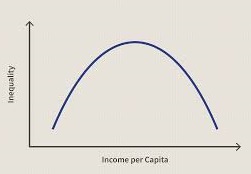
Kuznets Curve
"[E]xpresses a hypothesis advanced by economist Simon Kuznets in the 1950s & 1960s. According to this hypothesis, as an economy develops, market forces first increase and then decrease economic inequality." Wikipedia
Positively Brilliant References
-
Koshy, T. (2003). Discrete Mathematics & Its Applications. Academic Press.
-
Massaron, L. (2016). Regression Analysis with Python. Packt Publishing.
-
Russell, S. & Norvig, P. (2021). Artificial Intelligence: A Modern Approach. Pearson.
-
Ryan, M. (2016). Calculus for Dummies. For Dummies.
-
Schneider, M. (1994). A Beginner's Guide to Constructing the Universe: The Mathematical Archetypes of Nature, Art, & Science. HarperCollins Publishers.
About Ryan L Buchanan
I am re-skilling as a Data Analyst & Machine Learning Engineer. I
am currently enrolled in a Masters in Data Analytics. I am also
acquiring certifications as an ML Engineer & Algorithmic Trader from Udacity.
I have an MBA & an MS in Instructional Design.
I have a multi-displinary background including military intelligence,
psychology, linguistics, economics, virtual reality & educational technology. I have
worked abroad for ten years with military, universities & vocational schools.
I have working knowledge of Arabic, Chinese & French. I am very
mobile, able to relocate quickly, adapt easily to diverse working conditions
& have a current passport.
I have a passion for mathematics, statistics & artificial intelligence.
I am enthusiastic, highly self-motivated & enjoy presenting informative data
to decision makers. I am eager to work with dynamic teams to create
high quality products & services.